
Indigenous women fight gender-based violence in Brazil’s Amazon by building community networks, raising legal awareness, and creating local support systems across isolated territories.
For Cleocimara Reis Gomes, raising awareness of violence against Indigenous women is a central part of her work. As coordinator of the Indigenous Popular Legal Promoters of the Rio Negro project, she works with women across Indigenous communities in northwestern Brazil to help them recognize different forms of violence and understand their rights.
Gomes lives in Cartucho, a community in the Brazilian state of Amazonas, approximately four days by boat from the municipality of São Gabriel da Cachoeira. She coordinates work involving 23 Indigenous peoples across around 100 communities in the municipalities of São Gabriel da Cachoeira, Barcelos and Santa Isabel do Rio Negro.
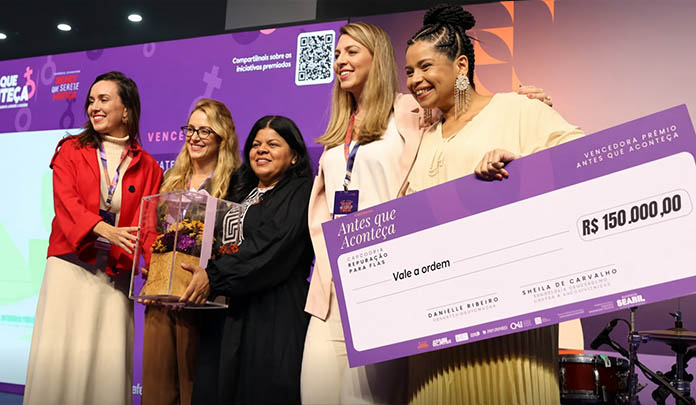
On November 4, 2026, the initiative received an honorable mention from Brazil’s Antes que Aconteça (Before It Happens) program during the international conference Women Who Move Justice in Brasília. The recognition highlighted the work of Indigenous women organizing to prevent and address gender-based violence in their communities.
Building Knowledge and Support Networks
The Indigenous Popular Legal Promoters of the Rio Negro project has organized three training sessions between 2021 and September 2026. The sessions brought together Indigenous women from the Upper and Middle Rio Negro region, preparing participants to become sources of information, guidance and support within their communities.
The training addressed different forms of gender-based violence and helped women identify situations of abuse, understand their rights and learn how to seek assistance.
An important part of the initiative is the development of a support network among Indigenous women. The network draws on traditional knowledge and community practices, while also introducing information about legal rights and available protection mechanisms.
The project aims to enable trained women to share what they have learned with others, creating local points of support for women who may otherwise have difficulty accessing information or assistance.
The Barriers Women Face in Remote Communities
Geographical isolation is one of the major challenges facing women in the Rio Negro region. Long distances between communities and urban centers can delay reports of violence and make it difficult for women to reach public services.
Gomes has also pointed to the different forms of violence experienced by Indigenous women, including physical, sexual, psychological and economic abuse. Violence can also be connected to pressures and invasions affecting Indigenous territories.
Fear and the difficulty of speaking openly about abuse create further obstacles. According to Gomes, helping women recognize violence and feel safe enough to discuss their experiences has been one of the project’s central challenges.
She has emphasized that violence should not be accepted as part of Indigenous culture and that women need to know they have the right to live free from abuse.
Connecting Community Knowledge with Legal Support
The training sessions combine discussions of community-based approaches to addressing violence with information about formal protection systems.
Participants learn about the institutions responsible for receiving complaints and supporting survivors, as well as relevant laws, protocols and procedures within health services, public security and social assistance.
According to Dulce Meire Mendes Morais, a gender adviser at the Socio-Environmental Institute (ISA), the initiative also examined the public services available to protect women and girls experiencing violence in the region.
The work contributed to a diagnosis of existing public facilities and support services, helping identify gaps in the protection available to women and girls.
The project is an initiative of the Socio-Environmental Institute (ISA) and the Federation of Indigenous Organizations of the Rio Negro (FOIRN), in partnership with the University of São Paulo’s School of Public Health and the Observatory of Gender Violence in Amazonas.
Women Speak Out and Shape the Next Steps
The experiences shared during the training sessions have also helped identify further needs within the communities.
Cleocimara Reis Gomes has said that women continue to face difficulties when seeking support, partly because the Women’s Department of FOIRN does not have its own dedicated structure to receive and assist all those who approach it.
She has also highlighted the need for training programs for men, an issue raised by women during the meetings.
Janete Alves Desana, vice-president of FOIRN, said the testimonies shared during the sessions showed how the initiative was encouraging women to speak about their experiences and strengthening their collective efforts to defend their rights.
Participants have also called for stronger commitments from public institutions to address violence in ways that are culturally appropriate for Indigenous communities. Other priorities include renewed efforts to establish a shelter for Indigenous women in São Gabriel da Cachoeira.
Recognition for a Collective Effort
The honorable mention presented in Brasília brought national attention to an initiative built through the participation and leadership of Indigenous women across the Rio Negro region.
For Gomes and the women involved, the work continues beyond the recognition. As Indigenous women fight gender-based violence, their central goals remain helping women identify violence, access information about their rights, support one another and connect with the institutions responsible for protection and justice.
Through training, community engagement and networks of mutual support, Indigenous women are strengthening their role in addressing gender-based violence and shaping responses within their own communities.