

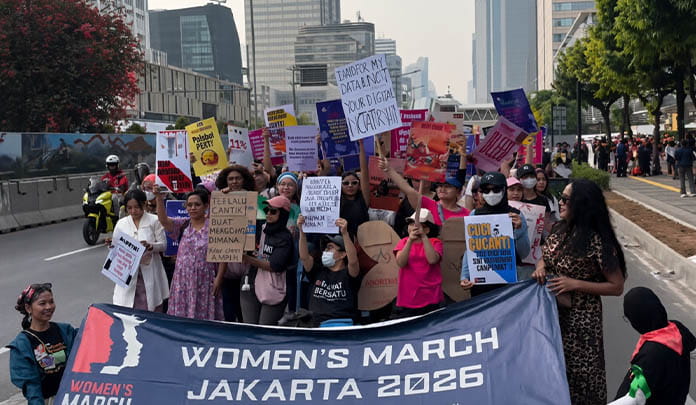
Women’s March Jakarta brought hundreds of participants to the streets of the central capital on November 7, 2026. Demonstrators demanded government policy changes, gender equality, and stronger protections for vulnerable groups.
Women Take Their Demands to the Streets
Hundreds of women took to the streets of central Jakarta on November 7, 2026. They called for changes to government policies and stronger protections for women and vulnerable groups. The Women’s March Jakarta brought together women, workers, Indigenous communities, environmental activists, and civil society groups. This demonstration connected gender equality with economic justice, civil liberties, and human rights.
The march began at around 6:30 a.m. near the Sarinah intersection. Participants then moved towards the Horse Statue area near the National Monument. They carried banners and posters while speakers delivered speeches outlining their demands.
Organisers chose the theme “The State Oppresses, We Resist.” The demonstration presented nine demands that linked directly to women’s rights and daily lives. These demands extended beyond gender-based discrimination. They addressed public spending, workers’ protection, environmental justice, and government accountability.
Nine Demands Address Women’s Rights and Wider Social Issues
The nine-point platform placed women’s rights within a broader framework of social and economic justice.
Organisers called for economic justice and universal social protection. They demanded lower prices for essential goods and higher national budget priority for public services. They also urged protection for care workers, labourers, and migrant workers. These demands highlighted the economic pressures on people whose work remains insufficiently recognised or protected.
A second demand called for an end to violence, discrimination, and criminalisation based on gender, sexuality, disability, religion, occupation, identity, and social status. Participants also demanded healthcare access and a life free from violence. This included access to reproductive healthcare, measures against femicide, and support for sexual violence survivors.
The platform also targeted violence in digital spaces. Organisers demanded an end to online gender-based violence and digital repression. They urged stronger protection for personal data, press freedom, and freedom of expression.
Other demands focused on human rights-based legislation and public participation in lawmaking. Participants demanded an end to the militarisation of civilian spaces and the criminalisation of human rights defenders. They also raised the situation in Papua, demanding an end to violence against local communities and what they described as Indonesian colonialism.
Environmental justice formed another key part of the platform. The march called for an end to development projects that take away community resources and living spaces. The final demand urged the government to stop public policies that endanger people. This included a call to review the Free Nutritious Meals programme if the state cannot guarantee public safety.
Women Connect Everyday Concerns with Public Policy
Several issues during the march showed how participants linked national policy decisions to daily life experiences.
Reuters reported concerns over the government’s response to forest fires, the cost of its free meal programme, and a tax on women’s sanitary products. Indonesian media also reported that demonstrators carried messages about access to menstrual products, violence against women, and the cost of essential goods.
These issues reflect basic dimensions of women’s lives: healthcare access, cost of living, safety, and environmental conditions. By connecting these topics, organisers placed everyday concerns within a wider debate on public policy and state responsibility.
The platform made clear that gender equality is inseparable from economic justice, environmental protection, civil liberties, and human rights. The demands addressed protections specifically for women as well as the broader social conditions affecting their communities.
Participants Face Police Blockade
The march encountered resistance as participants tried to move from Jalan MH Thamrin to the Horse Statue. Indonesian media reported that police officers blocked the route, leading to pushing between officers and demonstrators.
Despite the tension, participants continued voicing their demands. Reports described speeches and a choir performance during the demonstration.
Later that day, Women’s March Jakarta issued an emergency statement condemning an alleged attack near the National Monument. According to organisers, three unidentified individuals approached demonstrators, and one allegedly took a participant’s rainbow flag and tried to burn it.
NU Online Jakarta reported the incident based on the organisers’ statement. The cited reports have not independently established these allegations.
A Collective Call for Change
Women’s March Jakarta 2026 brought diverse groups together to make shared demands visible in the capital. Women and their allies used the action to address violence, reproductive healthcare, workers’ rights, public spending, environmental protection, and civil freedoms.
The nine-point platform placed women’s rights at the centre of a wider call for social change. Through their public action, participants showed that conditions shaping women’s lives connect directly to decisions about the economy, public services, the environment, and fundamental rights.
The march gave those demands a public platform and made women’s voices central to the debate over the country’s direction.