
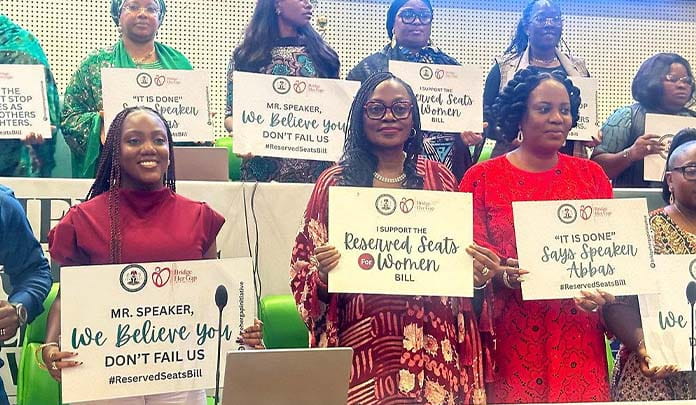
Nigeria’s National Assembly is considering a historic constitutional reform. This proposal aims to create 74 seats exclusively reserved for women in parliament. Announced on November 2, 2026, by Senate Leader Opeyemi Bamidele, the measure would allocate 37 additional seats to the Senate. Furthermore, it adds 37 seats to the House of Representatives. This guarantees every state a dedicated female lawmaker in both chambers.
Additionally, the Constitution Review Committee has recommended three reserved seats for women in each of the 36 State Houses of Assembly. Designed to operate for 16 years, this proposal represents a temporary affirmative-action mechanism. Although the legislation remains under consideration, its driving force is not a top-down gesture. Instead, it is the direct result of years of organized advocacy led by Nigerian women lawmakers and grassroots activists.
Women Legislators Leading Parliamentary Action
At the center of this campaign is Representative Kafilat Adetola Ogbara. She serves as Chair of the House Committee on Women Affairs and Social Development. Drawing on over two decades of advocacy, Ogbara has turned long-standing demands into constitutional reform.
Moreover, she is a primary co-sponsor of the Reserved Seats for Women Bill (HB 1349). Demonstrating strategic collaboration, Ogbara paused her own alternative proposal to unite lawmakers behind HB 1349. For Ogbara and her peers, the objective goes beyond mere participation. Crucially, they want to ensure women secure meaningful decision-making power.
A Nationwide Coalition Mobilizing 36 States
Beyond parliament, Nigerian women’s organizations coordinated a nationwide push. On March 25, 2026, a broad alliance presented formal petitions across all 36 states. This powerful coalition includes:
- League of Women Voters of Nigeria (NILOWV)
- National Council of Women Societies (NCWS)
- Nigeria Association of Women Journalists (NAWOJ)
- Federation of Muslim Women’s Associations of Nigeria (FOMWAN)
- International Federation of Women Lawyers (FIDA)
NILOWV President Irene Awuna-Ikyegh emphasized that this mobilization forces legislators to recognize public demand. Similarly, Adaora Onyechere Sydney-Jack highlighted that women’s collective action is vital for democracy.
Grounding Advocacy in Evidence and Data
The campaign’s structural reach is underscored by FIDA Nigeria’s 2025 project report. Demonstrating evidence-based advocacy, FIDA secured 135,398 citizen endorsements across nine target states. Consequently, by engaging over 1,300 community stakeholders, the initiative brought grassroots citizens directly into the reform process.
Overcoming Obstacles and Historical Resistance
This mobilization responds to severe political inequality. Current data shows women hold just 4 of 107 Senate seats (3.7%) and 15 of 356 House seats (4.2%). Therefore, women face massive structural barriers, including prohibitive campaign costs and gender-based violence. A 2024 analysis by PLAC confirmed that reserved seats offer a direct structural solution.
Furthermore, this push builds on past struggles, including a similar proposal in the Ninth Assembly that failed in March 2022. The renewed HB 1349 campaign has actively evolved, incorporating debate on seat allocation and selection models.
From Political Presence to Genuine Power
For the women leading this movement, the core issue is transforming political presence into power. Women have long anchored political campaigns across Nigeria yet remain excluded from governance. Therefore, the 74-seat proposal creates space for female leadership without displacing existing seats. As Nigerian women fight to pass this reform, they are proving that relentless advocacy can rewrite political structures.