

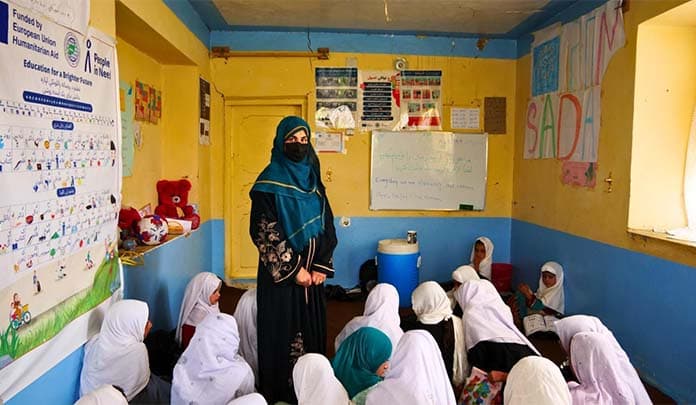
More than 2.6 million girls in Afghanistan have been denied access to secondary education since 2021, severely impacting Afghan girls education, according to a joint UNICEF and UNESCO report published on November 4, 2026. As restrictions keep girls out of classrooms and women out of universities, community-based classes and alternative initiatives are helping preserve access to learning.
Afghanistan remains the only country where girls and women are formally prohibited from pursuing education beyond primary level. Girls have been barred beyond Grade 6 since September 2021, and women excluded from universities since December 2022, creating an unprecedented crisis for Afghan girls education.
The consequences extend far beyond the loss of classroom instruction, interrupting millions of girls’ education, limiting future career opportunities, and separating them from supportive social environments for women’s rights.
A recent UNICEF account illustrates this daily impact. Shafiqa was 10 years old when restrictions began and completed Grade 6. She repeated the grade to remain in a classroom, dreaming of becoming a doctor. When secondary schools closed, she turned to art classes, then a computer course. Eventually, those options disappeared too.
Today, Shafiqa spends her time at home sewing and helping her mother, yet she still studies independently and believes in education. “Knowledge is more important than anything,” she says. “Education gives people the opportunity to build a better future.”
Future Challenges Beyond the Classroom
Despite these barriers, education has not completely disappeared. Local initiatives supported by international organizations provide learning opportunities, with women playing a vital role. By October 2026, about 5,300 community-based classes operated across Afghanistan, reaching 162,000 learners, with girls accounting for 64 percent.
These classes, alongside literacy and skills programs, represent rare educational pathways for Afghan girls education, though organizations stress they cannot replace formal education.
Rabia, a teacher in a UNICEF-supported community classroom in Herat province, was studying university mathematics before restrictions. She now guides 28 students through language, math, and life skills. Her classroom is a crucial lifeline for local children, including 10-year-old Fatema, who hopes to become a teacher herself.
In communities where parents hesitate to send daughters to male-taught classes, female teachers are essential. A May 2025 UNICEF report noted women made up only 34 percent of teachers, heavily limited in rural areas.
Future Challenges for Afghan Girls Education
For women and older girls unable to return to formal education, literacy and skills programs offer alternative paths. UNESCO-supported initiatives help Afghan women develop practical knowledge, support livelihoods, and improve economic independence, though the scale remains small compared to the vast need.
The broader crisis also impacts younger children. The November 2026 report found that 53 percent of primary school-age children in Afghanistan remain outside formal education, driven by poverty, population growth, and investment pressures. School-age population grew from 10.4 million in 2019 to 11.5 million in 2024, while enrollment failed to keep pace.
UNICEF and UNESCO call for full restoration of education rights for girls and women, alongside greater investments in teachers and schools.
For women like Rabia and girls like Shafiqa, individual determination fights to preserve a future. Yet, community classes cannot fully replace a system that denies millions the right to learn, and Afghanistan must ultimately restore an education system where every girl can return to school.