
Raden Adjeng Kartini: Pioneer of Women’s Rights in Indonesia
October 9, 2026
UN Expert Takes ‘No Execution Tuesdays’ Campaign Global
October 15, 2026
How Iran’s Legal System Enables Impunity for Femicide
In recent days, the shocking murder of a young mother on Iran’s Qeshm Island has once again brought the issue of femicide and honor killings into the media spotlight and social media conversations.
Two Saturdays ago, a 28-year-old mother named Maryam Yarmohammadi was killed in her own home in a relentless knife attack. Two men have been arrested on charges of murder and complicity in murder. The murder suspect is Ms. Yarmohammadi’s brother, while her husband stands accused of facilitating the crime by taking the children out of the house.
Reports indicate that Maryam Yarmohammadi’s killer stabbed her repeatedly in the neck, chest, and genital area.
Details emerging after the crime reveal further dimensions of the case. A group of Maryam’s relatives gathered outside the hospital to protest the arrest of her brother and husband.
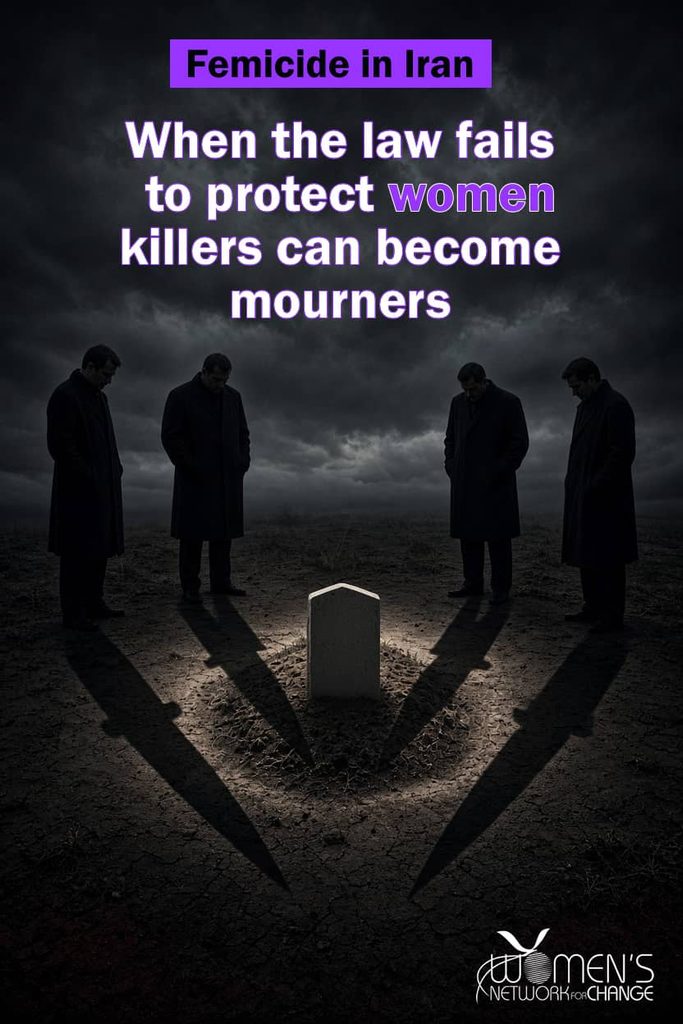
Following Maryam’s murder, her husband and brothers were listed as the chief mourners on her funeral notice.
When the Law Hands the Weapon to the Killer
The main question is not why a brother resorted to murder. The main question is why killers so openly defend their actions like this.
Under the rule of the mullahs, misogynistic laws have driven a soaring and shocking rise in honor killing statistics across Iran.
Article 630 of the Islamic Penal Code:
Grants a husband the legal authority, upon witnessing his wife’s alleged adultery, to effectively assume the roles of both judge and executioner and kill her on the spot.
Article 301 of the same Code:
Exempts a father or paternal grandfather from qisas (retribution-in-kind, including the death penalty) for the murder of their child. In practice, this provision creates a framework of impunity that can facilitate so-called “honor” killings of daughters by fathers or paternal grandfathers, or result in perpetrators facing only significantly reduced punishments.
These laws do not deter violence; rather, they grant a “license to kill by law.”
The Tip of the Iceberg: Femicide in the Shadow of Structural Silence
What happened to Maryam is not an isolated incident; it is merely the tip of the iceberg of a silent, widespread crime.
Mai Sato, the UN Special Rapporteur on the situation of human rights in Iran, stated in a report published in March 2025 that at least 179 cases of femicide were recorded in Iran during 2024. The report also highlights the absence of comprehensive legislation to combat domestic violence and points to critical gaps in legal protections for women. This figure reflects only recorded cases and does not necessarily encompass all femicides committed across the country.
The lack of comprehensive, up-to-date official statistics makes it difficult to assess the true scale of femicide in Iran. Nevertheless, reports from the United Nations and human rights organizations demonstrate that lethal violence against women, including murders committed by husbands or other family members, remains a severe women’s rights issue in Iran.