

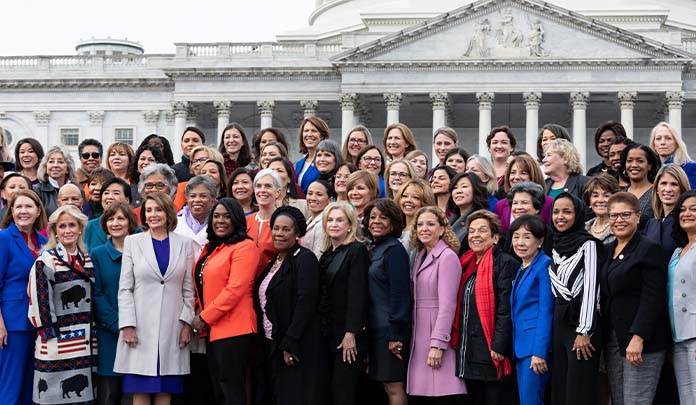
More than 100 Democratic women in the House of Representatives have secured election victories in the 2026 U.S. midterm elections, marking a historic milestone in women’s political representation. The latest figures show that at least 115 Democratic women have won House seats, surpassing the previous record of 95, set in 2025.
The results point to a significant shift in the composition of the next Congress, although they do not yet mean gender parity in the chamber. According to the Center for American Women and Politics (CAWP) at Rutgers University, at least 136 women are expected to serve in the House in 2027. This includes 115 Democratic women and 19 Republican women who have already won their races, as well as two unresolved contests in which both major-party candidates are women.
Democratic Women in the House: A Historic Shift in Representation
The increase in Democratic women in the House marks a new high for the party and a notable change from previous election cycles. The Democratic Women’s Caucus announced on November 4 that more than 100 Democratic women had been elected to serve in the 120th Congress. The caucus also said its House membership would exceed 100 for the first time, representing an increase of more than 60 percent since 2016.
The broader picture of women’s representation is also changing. CAWP’s November 7 tracker estimates that at least 159 women will serve in the 120th Congress, including members of both the House and Senate. This would exceed the previous congressional record of 152 women, set in 2024.
These figures show progress across the political system, but the record gains are particularly notable among Democratic candidates. The election results should therefore be understood as a milestone for women’s representation, while also reflecting the political and party dynamics of the 2026 midterms.
From Campaign Support to Political Representation
The growing presence of Democratic women in the House did not happen in isolation. Political organizations, campaign networks, party leaders and grassroots supporters have played a role in recruiting candidates, raising funds and helping women compete for elected office.
In a November 4 statement, former House Speaker Nancy Pelosi highlighted the work of Democratic leadership, the Democratic Congressional Campaign Committee, the Democratic Women’s Caucus, Elect Democratic Women, labor organizations and women’s groups in supporting female candidates.
EMILY’s List, an organization that supports Democratic women candidates who support abortion rights, also described the results as a historic achievement. The organization said it had helped elect 227 Democratic women to the U.S. House since its founding in 1985.
Such networks can help address some of the barriers women face when entering electoral politics, including access to campaign funding, institutional support and established political networks. Their role also illustrates how broader organizing efforts can contribute to increasing women’s presence in elected institutions.
Women’s Representation and the Legislative Agenda
A larger number of women in Congress can bring a wider range of experiences and perspectives into legislative debates. The Democratic Women’s Caucus has identified issues including economic opportunity, healthcare, reproductive freedom and protection from violence as key areas of concern.
For Democratic women in the House, increased representation may create more opportunities to raise these issues, participate in policy discussions and influence legislative priorities. However, the number of women elected to office does not automatically determine legislative outcomes. Their ability to shape policy also depends on committee assignments, party leadership, political alliances and the balance of power in Congress.
The distinction between women’s presence in political institutions and their ability to influence policy remains important when assessing the significance of the election results.
Progress, but Not Gender Parity
Despite the historic gains, women will still account for only about 31.3 percent of the House of Representatives in 2027, according to CAWP. The result is a record, but it remains far from equal representation.
The record number of Democratic women in the House is an important development in the long effort to expand women’s political participation in the United States. It also raises a broader question: whether a larger presence of women in elected office will translate into lasting influence over the policies and decisions that shape public life.
For now, the 2026 midterms have established a new benchmark for women’s representation in the House. Whether this milestone leads to sustained political influence will depend on what these newly elected representatives are able to achieve in the years ahead.