
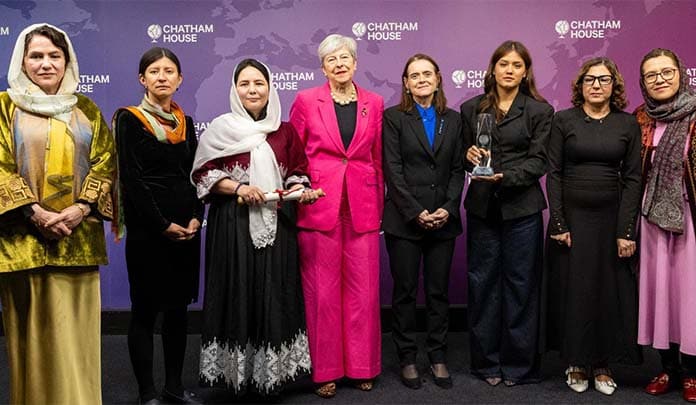
Afghan women have received the 2026 Chatham House Prize. Moreover, this award honors their collective efforts to defend rights. Consequently, they preserve opportunities for women and girls under Taliban rule.
Theresa May presented the award on Monday, November 9, as the ceremony took place in London. Notably, Theresa May is the former British prime minister and president of Chatham House. Elaha Safdari accepted the prize on behalf of Afghan women, serving as the goalkeeper for Afghanistan’s national women’s football team.
Meanwhile, Lyse Doucet moderated a panel discussion at the ceremony. As the chief international correspondent for the BBC, she guided the conversation. Five Afghan women activists and public figures used this event to highlight restrictions on girls and call for global support.
Afghan Women Bring Demands to a Global Platform
The panel featured five prominent figures. First, Zahra Joya founded Rukhshana Media as editor-in-chief. Next, Shaharzad Akbar led the Afghanistan Independent Human Rights Commission previously. Orzala Nemat directs the Development Research Group. Additionally, Fawzia Koofi served as deputy speaker of parliament, while Benafsha Yaqoobi established the Rahyab Initiative.
Joya spoke about the award first. She said it sent a powerful message. Therefore, the world has not forgotten Afghan women, and people will continue to hear their voices.
Akbar shared her perspective next. Specifically, she noted that the recognition offers hope. Thus, it reminds girls denied an education that they remain remembered.
Furthermore, Nemat discussed humanitarian concerns. She urged the international community to act. As a result, global leaders must advocate for girls’ education and women’s employment.
In contrast, Koofi criticized Taliban policies and highlighted a stark double standard. Although authorities bar girls from secondary and higher schools, officials send their own daughters to study.
Finally, Yaqoobi addressed the international response. She criticized global authorities and called attention to their responsibilities toward Afghan women and girls.
‘Becoming a Refugee Was Never My Dream’
A central moment arrived during Safdari’s speech. She accepted the award for all Afghan women after fleeing to the United Kingdom in 2021. During her remarks, she spoke about the personal cost of displacement.
“Becoming a refugee was never my dream,” she stated. “Leaving Afghanistan meant leaving behind my home, my friends, my teammates, my family.”
Safdari also thanked the UK government and Girl Power, a sports organization. Because they supported Afghan women through difficult times, their work proved vital. Furthermore, she emphasized football’s role, noting that the sport keeps Afghan women visible globally.
Subsequently, she reminded the audience of simple wishes. Girls inside Afghanistan want normal lives. For instance, they want to attend school and play sports. Ultimately, they want to decide their own futures.
Her remarks refocused the conversation on the everyday aspirations of Afghan girls. However, their access to public life remains sharply restricted.
Recognizing Collective Resistance
Chatham House announced the award details and highlighted ongoing resistance efforts. Afghan women defend their rights despite severe restrictions. Specifically, these barriers affect education, employment, and public participation since 2021.
Women lead initiatives inside Afghanistan and abroad. For example, their work includes protests and underground schools. In addition, they document human rights abuses and build support networks.
Bronwen Maddox serves as Chatham House CEO. She praised Afghan women’s courage and stated that they challenged governments. Consequently, leaders must question engagement terms with the Taliban. Moreover, she added that women’s treatment is a global matter.
May delivered closing thoughts as well. She urged the international community to stay vigilant. Therefore, people must not allow the crisis to fade from public attention.
The ceremony also featured a special film. Broadcaster Yalda Hakim contributed to it, alongside UN representative Susan Ferguson and activist Onaba Payab. Meanwhile, local women shared hidden reflections, though organizers hid their identities for safety.
Chatham House established this prize in 2005 and awards it annually. Winners make significant contributions to international relations. Accordingly, members select recipients through nominations.
In conclusion, the 2026 award honors collective resilience. While it recognizes existing restrictions, it also celebrates continuous community support. Above all, these women defend education and shape their nation’s future.