
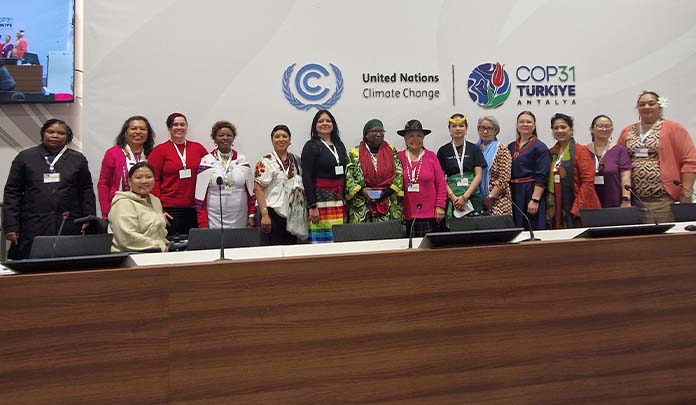
More than 50 leaders from across the globe gathered in Antalya, Türkiye, on November 5–6, 2026. They met to build a shared position on Indigenous women climate justice. The International Indigenous Women’s Forum (FIMI) organized the meeting ahead of COP31. It brought together women from Africa, Asia, the Pacific, the Arctic, North America, Latin America, and the Caribbean.
Their political declaration delivers a clear message. Indigenous women must hold greater influence over climate decisions affecting their communities and territories. They also need direct access to the resources required to tackle the crisis.
Active Drivers of Change, Not Passive Beneficiaries
A central demand of the declaration is direct, flexible, and predictable climate funding. Indigenous women’s organizations and networks urgently need this support. Complex bureaucratic rules often stop community-based initiatives from securing necessary resources.
The signatories urge international funding institutions to change their approach. They want these bodies to recognize Indigenous women not merely as beneficiaries of outside projects, but as active leaders who build and run their own climate initiatives. Funding must respect the autonomy and priorities of Indigenous communities.
Recognizing Indigenous Knowledge and Protecting Defenders
The declaration urges policymakers to include Indigenous women’s knowledge and experience in climate strategies. This encompasses traditional knowledge tied to land, water, biodiversity, seeds, and local food systems passed down through generations.
Furthermore, the signatories want policies to reflect the perspectives of Indigenous youth, older women, and women with disabilities.
Another major concern involves the safety of women defending their ecosystems. According to FIMI, Indigenous women environmental defenders face severe threats. Opposing activities that damage their territories often results in intimidation, criminalization, displacement, and killings.
Consequently, the declaration calls on governments to provide stronger legal protections and dedicated public resources. Officials must address the violence and intimidation linked to the exploitation of Indigenous lands.
Rights-Based Climate Solutions for Indigenous Women Climate Justice
Indigenous women warn that false climate solutions create new threats. This happens whenever local communities remain excluded from decision-making processes.
The declaration highlights serious concerns regarding renewable energy developments, mining, hydropower, and carbon offset projects. Such projects frequently endanger Indigenous territories and accelerate land grabbing or displacement.
To prevent this, the signatories demand strict adherence to the principle of Free, Prior and Informed Consent (FPIC). This principle gives communities the right to receive relevant information and freely decide whether to accept or reject projects before they begin.
They also demand immediate action to stop forced displacement and gender-based violence linked to these commercial activities, which remains vital for Indigenous women climate justice.
Protecting Culture and Securing a Voice in Climate Policy
The declaration addresses profound losses that extend beyond economic damage. Climate threats endanger native languages, cultural practices, traditional knowledge, and the spiritual bonds communities share with their ancestral lands.
The signatories insist that climate policies must recognize these non-economic losses. They also demand stronger backing for the Fund for Responding to Loss and Damage. Alongside this, they request direct funding channels for Indigenous communities and women’s groups.
On a broader scale, they seek explicit recognition of their rights. They want active participation in international gender and climate policies, including full implementation of the Belém Gender Action Plan.
From Demands to Action on Indigenous Women Climate Justice
The declaration outlines clear recommendations for governments, global institutions, and climate finance mechanisms. However, publishing the document does not mean authorities have accepted or implemented these demands.
As COP31 gets underway in Antalya, the women’s statement brings attention to the gap between their contributions to climate action and the limited access to funding and decision-making power they say they continue to face. Whether their demands for Indigenous women climate justice lead to meaningful change will depend on how governments and international institutions respond.