
One year after authorities declared gender-based violence a national disaster, Women For Change is turning public protest into a demand for government accountability, action and lasting change.
SOUTH AFRICA | NOVEMBER 2026
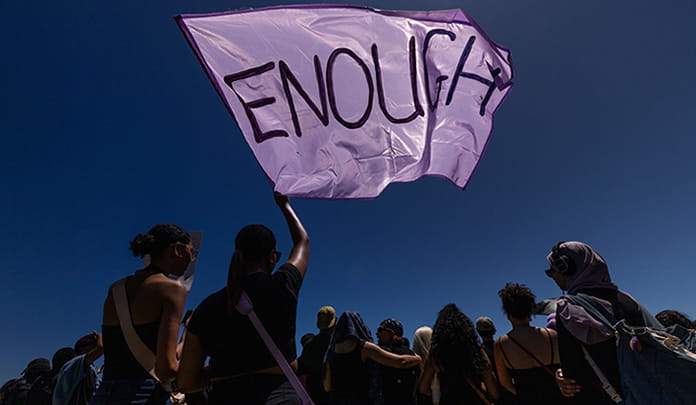
At midday on 21 November 2026, women across South Africa lay down for 15 minutes to remember those killed by gender-based violence and femicide. At Constitution Hill in Johannesburg, demonstrators dressed in black and purple gathered to honour the victims. They sent a clear message to the government: women cannot wait for promises while gender-based violence in South Africa remains a daily reality.
The advocacy movement Women For Change organised the nationwide protest. It marked one year since the government classified gender-based violence and femicide (GBVF) as a national disaster. Yet the return to the streets showed that official recognition alone has not satisfied campaigners. Now, their demands focus on concrete steps: funded action plans, clear responsibilities and public accountability.
From Public Solidarity to Collective Action
The November 2026 mobilisation builds on a wider movement. It aims to turn individual experiences of violence into a national demand for change.
In November 2025, Women For Change launched a major campaign calling for GBVF to become a national disaster. According to the organisation, more than 1.1 million people signed its petition. Over 750,000 people also changed their social media profile pictures to purple as a sign of solidarity.
The campaign brought widespread public attention to the crisis. On 20 November 2025, President Cyril Ramaphosa officially classified gender-based violence and femicide as a national disaster.
This step marked an important moment for activists and supporters. One year later, however, the movement returned with a sharper message: recognition must lead to results.
This time, campaigners did not focus solely on raising awareness. Instead, they demanded proof that the government is implementing its commitments.
Behind the Numbers: A Crisis That Persists
New police statistics released shortly before the protest underline the scale of the challenge.
Between July and September 2026, South African police recorded 9,908 rape cases. Investigators verified the victim’s age and sex in 9,705 of these cases. Of those, 5,116 involved adult women and 4,362 involved children. During the same period, perpetrators murdered 581 women and 149 children.
These figures reflect only reported and recorded cases. They do not show the full extent of violence, because survivors never report many incidents to the authorities.
For women campaigning against gender-based violence, the numbers reinforce a harsh reality. Declaring a national disaster does not automatically make women safer.
The data also highlights urgent gaps. The country needs stronger prevention, accessible support services, effective investigations and a justice system that treats survivors with dignity.
A Protest With Specific Demands
At Constitution Hill, demonstrators held a march, carried a symbolic casket and staged a 15-minute lie-down. The action honoured women who lost their lives. It also highlighted the duty of public institutions to prevent further violence.
The movement handed a memorandum to the government. Its demands go far beyond general promises to tackle GBVF.
Campaigners called for a fully funded and time-bound implementation plan, along with clear duties for government departments. They also demanded transparent statistics on femicide and child murders, regular public progress reports and independent oversight.
These demands show an important shift in the campaign. Women no longer simply ask authorities to acknowledge the problem. They want to know what officials are doing, how they spend public money and who faces consequences if they fail to deliver.
According to reports from the protest, Minister Sindisiwe Chikunga received the memorandum. She committed to responding within 30 days.
Government Funding: Promises Must Become Results
The government has also announced new financial commitments to strengthen its response.
On 13 November 2026, Chikunga outlined a R5.1-billion package to tackle gender-based violence. The plan allocates R3.8 billion to recruit 3,552 social workers and R186 million to strengthen forensic and investigative capacity. It also aims to expand sexual offences courts from 55 to 101.
Furthermore, the government plans to increase the number of Thuthuzela Care Centres from 72 to 80 by the 2028/29 financial year. These centres provide vital support to survivors of sexual violence.
These investments could improve access to care and strengthen the justice system. However, the minister also acknowledged that the National Strategic Plan on GBVF and disaster management plans still face funding shortages.
This raises a central question: how much of this funding will reach the services that women actually use?
For campaigners, real change requires full implementation, not just financial announcements. Recruiting social workers, improving investigations and expanding support centres must produce measurable improvements in women’s safety and access to justice.
Turning Collective Voices Into Lasting Change
The impact of Women For Change extends beyond the November demonstration. Its campaign shows how women can organise around shared concerns and build public solidarity. Through collective action, they can press institutions with power to change policy.
The movement has placed gender-based violence in South Africa at the centre of national debate. Its latest mobilisation shows that women also want an active role in monitoring what happens after politicians make promises.
There is still no basis to conclude that the campaign has achieved lasting structural change. The scale of recorded violence and the funding shortages show that major obstacles remain.
Still, the movement has reshaped the public conversation. The central question is no longer whether gender-based violence is a national crisis. Instead, people are asking whether government institutions can prove their response is effective, properly funded and accountable.
For the women who returned to the streets, the message was clear: a declaration is not protection, a promise is not implementation and remembrance is not justice.
Their demand is simple yet far-reaching. Authorities must turn recognition into action and make women’s safety a measurable public responsibility.