

From Argentina to Mexico and South Africa, three movements show how women turn sorrow and anger into collective pressure. Through sustained action, they push for real social and political reform.
Violence against women often persists where society treats it as normal. For example, survivors go unheard in homes, streets remain unsafe, and institutions ignore serious complaints. Yet across different regions, women have refused to stay silent. By naming victims and organizing mass protests, they have turned private tragedy into a public and political demand.
Ultimately, the experiences of Argentina, Mexico, and South Africa reveal how gender-based violence movements emerge from deep loss. However, turning street protests into lasting justice remains a difficult and unfinished task.
Argentina: When One Teenager’s Name Became a Rallying Cry
In May 2015, the murder of 14-year-old Chiara Páez shocked Argentina. She was pregnant when authorities found her body at her boyfriend’s home in Rufino. Consequently, the killing became a flashpoint for nationwide demonstrations against femicide under the slogan Ni Una Menos (“Not One Less”).
On June 3, 2015, tens of thousands of people marched in Buenos Aires and dozens of other cities. Journalists and writers sparked the initial call to action. Soon after, the mobilization grew beyond a media campaign and united women’s groups, victims’ families, and everyday citizens. Their central message was clear: society could no longer treat femicide as an unanswered fate.
As a result, the movement pushed gender violence into the center of public debate. It also created a platform for demands around safety, access to justice, and state responsibility. Argentina had already passed Law 26.485 in 2009 to prevent and punish violence against women. Therefore, the 2015 protests did not create this law. Instead, Ni Una Menos mattered because it exposed the gap between laws on paper and women’s lived reality.
Mexico: From Campuses to the Streets Against Violence and Impunity
In Mexico, resistance against femicide and gender violence has a long history. However, a wave of protests by young women in 2019 and 2020 gave the struggle renewed urgency. At the National Autonomous University of Mexico (UNAM) and other schools, students staged rallies and strikes. They protested sexual harassment, assault, killings of women, and dismissive official responses.
A major turning point came in August 2019 in Mexico City. After allegations that police officers sexually assaulted a woman, dismissive remarks by city officials fueled public outrage. In response, women marched under the slogan No Me Cuidan, Me Violan (“They Don’t Protect Me, They Rape Me”). This placed deep distrust of security institutions at the center of the protests.
On March 8, 2020, massive women’s marches filled the streets. The next day, women launched the campaign Un Día Sin Nosotras (“A Day Without Us”). They stayed away from workplaces, universities, schools, and public spaces to show life without their participation. Thus, they turned resistance against gender-based violence into visible collective leverage.
Mexico had already enacted the General Law on Women’s Access to a Life Free of Violence in 2007 and added femicide to federal criminal law in 2012. Yet ongoing protests prove that legal frameworks alone do not stop killings or end impunity. In Mexico, gender-based violence movements have focused sharply on this distance between legal rights and real-world safety.
South Africa: 24 Demands to End Gender-Based Violence
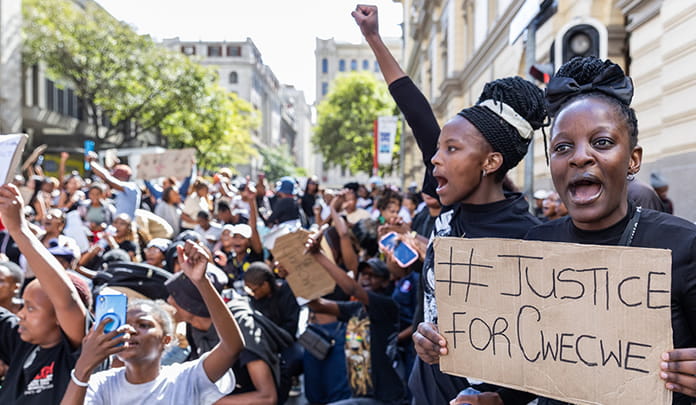
In South Africa, one of the most prominent movements against gender violence is The Total Shutdown. On August 1, 2018, thousands of women and gender-nonconforming people marched across the country. Rather than reacting to a single crime, participants sought to hold the state accountable for widespread gender-based violence and femicide.
Protesters presented the government with a memorandum of 24 concrete demands. These covered perpetrator accountability, justice reform, education, survivor support, and a coordinated national response. Above all, they demanded a national summit to confront the crisis.
This civic pressure led to formal policy steps. In November 2018, a Presidential Summit on Gender-Based Violence and Femicide brought government and civil society together. Afterward, officials and civil society representatives developed the National Strategic Plan on Gender-Based Violence and Femicide (2020–2030). The plan emphasized cross-agency coordination, accountability, and community participation.
This experience shows that street protest, paired with clear demands, can push an issue into formal state planning. At the same time, adopting a national plan is not the finish line. Implementation, funding, and institutional accountability remain decisive.
Indeed, that gap between policy and practice resurfaced in November 2026. Nationwide Women’s Shutdown demonstrations, led by Women For Change, brought protesters back to the streets across South Africa. Demonstrators demanded real funding, transparent implementation, and accountability for commitments already made on paper.
From Protest to Change: Work That Still Continues
Despite different political and social contexts, these three experiences share a common thread. In each country, women refused to let violence remain just another headline, court file, or family grief. In Argentina, one teenager’s name became the banner of a mass movement. Meanwhile, students and activists in Mexico turned streets and public life into arenas of demand. Similarly, women in South Africa translated their grievances into structured state demands.
Yet we cannot measure the impact of gender-based violence movements only by crowd sizes, slogans, or new laws. Deeper questions still remain: Are women safer after protests? Do authorities take their complaints seriously? Do courts hold perpetrators accountable? Moreover, do governments provide budgets and oversight to deliver on their promises?
The experiences of these countries offer no simple or final answer. However, the decisive role of women who broke the silence is undeniable. Ultimately, the struggle for women’s rights moves closer to real change when protest leads not only to recognition, but to lasting safety, justice, and accountability.